
Dyslexia – Making Reading Easier For Everyone
Dyslexia and Neurodiversity – Making Reading Easier for Everyone Many people in the UK, as well as worldwide, struggle with reading. This is not about intelligence; it’s about how books...
Welcome to Dyslexia A2ZI’m Maria Chivers — author, advocate, and neurodiversity specialist with over 35 years’ experience. Dyslexia A2Z offers clear, practical information and tools to help children and adults with dyslexia, dysgraphia, dyscalculia, ADHD, dyspraxia, and related learning differences thrive at home, school, and beyond. Find Out More
A warm welcome to you all, and I hope this new year finds you healthy and well.
As many of us know, the state of SEND provision in the UK is currently facing immense challenges. Parents, teachers, and broader educators are deeply concerned about how we will continue to support children who need additional help, especially as demand rises and resources decline.
More recently, there have been concerning discussions about reducing support for children with neurodiversity and learning differences. For families without access to private resources, this is especially alarming. When support becomes a privilege rather than a right, the impact is felt not only by the child but also by their parents, siblings, and teachers.
And teachers themselves are under unprecedented pressure. As reported in the Teacher Wellbeing Index 2025, the education workforce is at “crisis point”. The report highlights that unwell teachers simply cannot deliver high-quality education, and this year’s overall wellbeing score is the lowest since recording began in 2019. Key findings include:
The report calls for targeted interventions, such as professional supervision and reflective practice, to reduce burnout and improve leaders’ well-being. The findings are not just alarming; they are instructive. They highlight where the system is breaking, why staff are struggling, and what schools can realistically do to protect their workforce.
Against this backdrop, many families are left asking: If schools don’t have the resources to support neurodiverse children, what will happen to them? And what can we do as a community to ensure they are not left behind?
Best wishes
Maria Chivers
Writing by hand is more than putting letters on paper; it connects motor skills, memory and expression. Through our awareness campaigns (including International Dysgraphia Awareness Day), we invite schools, parents and children to explore the joy of writing, even when writing feels hard.
Check out how simple puzzles can really help with handwriting.
· Strengthen fine motor skills – build finger muscles for pencil grip
· Improve eye–hand coordination – copying shapes and letters
· Develop spatial awareness – letter orientation & spacing (e.g., b vs d)
· Boost focus and perseverance – staying on task during writing
Encourage
“Puzzles are a playful yet practical bridge into handwriting.
They build the finger strength, coordination, spatial skills, and focus that underpin confident writing.”
Please see the company below; they are excellent.

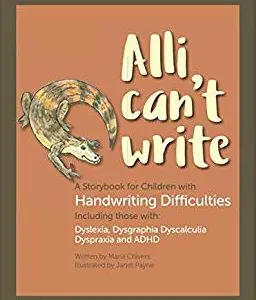
Alli Can’t Write: A Storybook for Children with
Handwriting Difficulties — and a Guide for Adults Who Want to Help
Alli Can’t Write is a heartfelt, two-part book combining a charming illustrated story for children with a powerful resource section for adults. Created by acclaimed neurodiversity advocate Maria Chivers, this book speaks directly to children struggling with handwriting, especially those with dysgraphia, dyslexia, dyspraxia, ADHD, and similar learning differences.
In the children’s section, we meet Alli-Gator, a bright and imaginative young alligator who loves school but becomes withdrawn when he’s told his writing is “sloppy” and unreadable. Despite his best efforts, Alli can’t seem to get his thoughts on paper. With the help of his supportive Mummy and Daddy-Gator, a kind school psychologist named Dr. Dolphin, and a thoughtful teacher, Alli begins to understand that his difficulties have a name, dysgraphia, and that he’s far from alone. Through games, special strategies, and lots of encouragement, Alli learns to work with his challenges and find joy in expressing himself again.
The story is rich with humour, empathy, and unforgettable characters, including Skunky, Hoppy and Jumpy the opossums, and the ever-patient Miss Snake. Set in the vibrant Florida Everglades and featuring endangered animals, the story not only entertains but also raises awareness of ecological issues.
The second part of the book is a comprehensive guide for adults, parents, teachers, and professionals, offering expert insights into identifying and supporting children with handwriting difficulties.
Topics include:

Dyslexia and Neurodiversity – Making Reading Easier for Everyone Many people in the UK, as well as worldwide, struggle with reading. This is not about intelligence; it’s about how books...
Should Children Learn to Touch-Type? With the holidays here, it’s the perfect time for children to start learning touch typing. The great thing is, it can be done anywhere! All...
A Smile as Big as the Moon: Inspiring Every Learner’s Potential Discover how A Smile as Big as the Moon celebrates inclusion, perseverance, and the power of believing in every...