Dyslexia & Disabled Student’s Allowance (DSA)
Suppose you have Dyslexia, Dyscalculia, Dysgraphia or other Learning Difficulties, and you are a student in higher education (or intending to go into higher education). In that case, you may be able to claim the Disabled Student’s Allowance (DSA).
Disabled Student’s Allowance (DSA) is a grant available for students in the UK studying full-time (and some part-time) courses at a university. You may also get the DSA if you take classes at the “Open University”.
You will usually need a full Educational Psychologist assessment showing the support you specifically require. (The university may pay for this, but check with them first.) If this shows positive for dyslexia, dysgraphia, dyscalculia or other learning difficulties, a grant of up to £8,400 (2023-2024) is available and can be used to pay for
- specialist “hardware equipment”, such as
- a specialist computer
- a printer,
- a scanner and
- recording equipment etc.
- Specialist software, such as
- Speech Recognition Software (SRS)
- Grammarly
- Mind Maps etc
- Specialist tuition (including study skills).
This grant is not ‘means-tested’; you do not have to pay the funding back.
Level Playing Field
These special provisions are because students with dyslexia or other SpLD often take much longer or need more specialised equipment to complete their work. These additional allowances give them a ‘level playing field’.
The responsibility to do this is enshrined in the Equality Act 2010, which includes dyslexia as a recognised disability.
Educational Psychologists
Educational Psychologists are fully qualified and independent professionals with significant experience in Dyslexia, Dyscalculia, Dysgraphia, Dyspraxia, Attention Deficit Hyperactivity Disorder (ADHD) and other Learning Difficulties.
While educational psychologists are often seen as expensive, they are well worth their money. The report you will receive will give extensive and detailed recommendations for both equipment and specialised tuition you may require. You usually only need one report, often obtained just before you start university.
In the last couple of years, the rules have changed regarding the date of the reports. Now, providing you have an Educational Psychologist Report stating you have severe dyslexia etc., you do not need to update it. However, I think if the report is several years old; it would be beneficial for you to get an up-to-date report to see your progress from the previous test. You may qualify for these allowances, so the monies spent on the report will not be wasted. It should be noted that if you use the same psychologist for an up-to-date test, they do not usually charge the total price to update it.
Dyslexia Checklist
If you think you have dyslexia but have never had a test, have a look at my dyslexia checklist, it may help you.
John Hicks has an excellent Student Blog and discusses DSA. I am studying dyslexia.
For further information about Student Finance England, go to Gov UK – Disabled Students Allowance.
Personal Independence Payment (PIP) & Dyslexia
Personal Independence Payment (PIP) & Dyslexia
Individuals with severe dyslexia or other learning difficulties may be entitled to Personal Independence Payment (PIP).
Learning difficulties include;
- Dyslexia,
- Dyscalculia,
- Dysgraphia,
- Dyspraxia,
- Attention Deficit Hyperactivity Disorder(ADHD),
- Seasonal Affective Disorder (SAD),
- Nonverbal Learning difficulties (NLD),
- Oppositional Defiance Disorder (ODD),
- (AS),
- Cerebral Ataxia
- and some other learning difficulties.
Reports must be post-16 (i.e. after 16); therefore, if you had one at school, this may need to be updated to qualify for these allowances. However, many psychologists do not usually charge the same price for reports if they did the previous one and always check first.
For further information about Student Finance England, go to Gov UK – Disabled Students Allowance.
Dyslexia & Employment & Support Allowance (ESA)
Dyslexia & Employment & Support Allowance (ESA)
You may get Employment and Support Allowance if you have an illness or disability that affects your ability to work. If you already receive this benefit, you may be able to carry on receiving it as a student. You can get more information about claiming benefits while studying from your local Jobs and Benefits office.
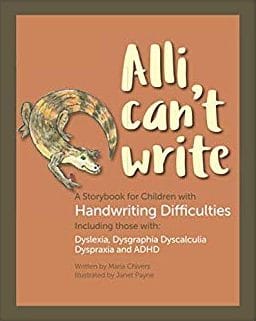
Alli Can’t Write
A Storybook for Children with Handwriting Difficulties.


